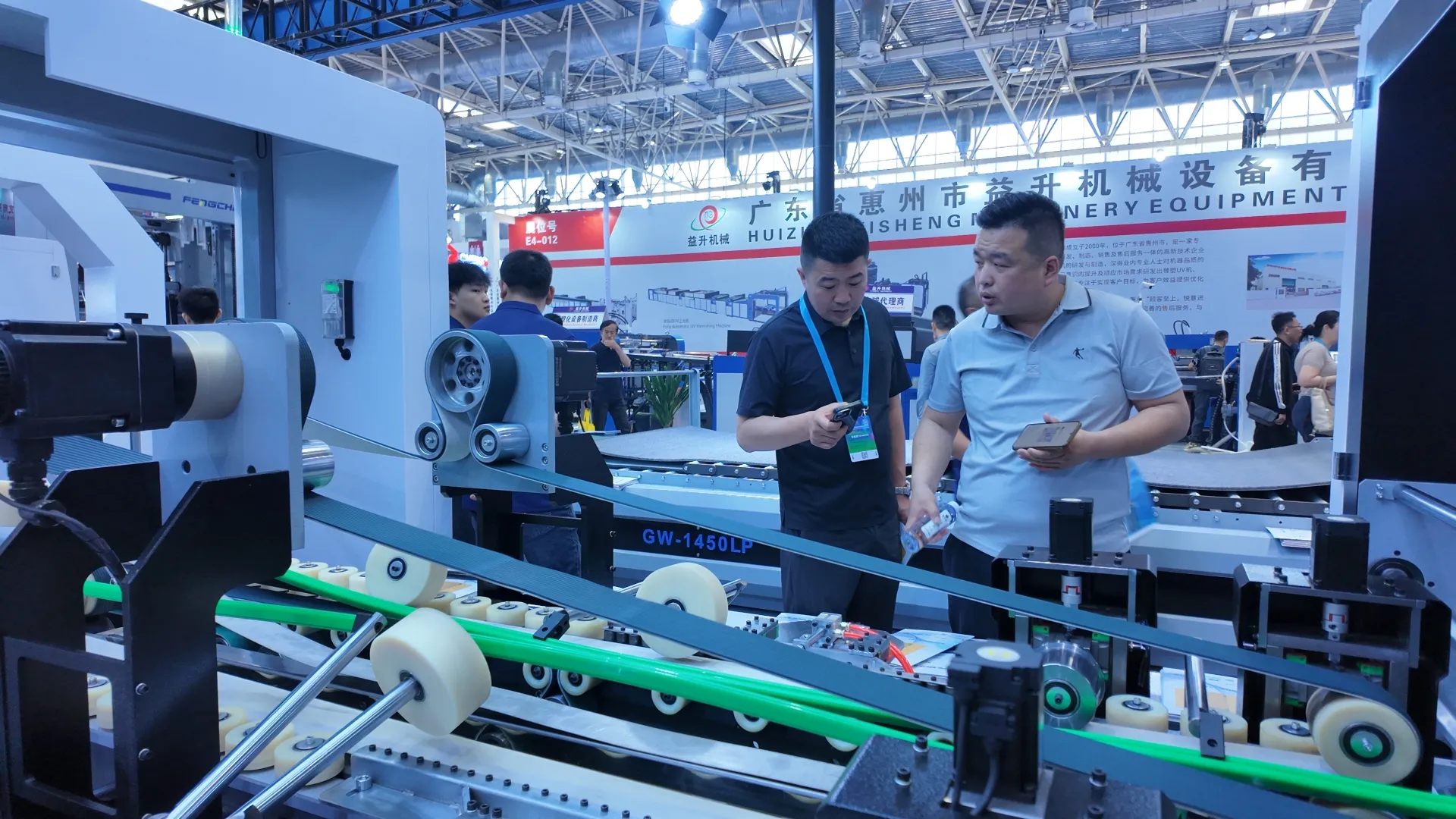
Here’s a question every packaging plant manager eventually faces: how much faster does your next flute laminator need to be to actually change your bottom line? Not “spec sheet fast.” Not “sales pitch fast.” I mean the kind of speed that shows up in your daily output numbers and your P&L statement.
The difference between a machine that runs 10,000 sheets per hour and one that runs 17,500 sheets per hour is not just 75% more sheets. It changes how you bid on jobs, how many shifts you run, and whether you can take on a rush order without breaking your production schedule. This article compares real operating speeds across the flute laminator market and explains why that 17,500 number matters more than most buyers realize.
Key takeaway: The Fengchi GS-1700LP flue laminator delivers 17,500 sheets/hour stable throughput (185 m/min) with ±1.0mm lamination accuracy. That speed tier puts it well ahead of most competitors while matching or exceeding their precision. But the number alone is only half the story — sustained output under real factory conditions is where the gap widens.
The speed landscape: where do flute laminators actually sit?
Not all “high-speed” claims mean the same thing. Some manufacturers quote peak speed (the fastest the machine can briefly hit), others quote stable speed (what it can sustain across an 8-hour shift), and a few quote neither — they give you a meter-per-minute figure and let you do the math.
Here is a side-by-side look at what major flute laminator brands actually deliver, based on published specifications and independently verified test data:
| Brand / Model | Max Speed (sheets/hr) | Stable Speed | Line Speed | Accuracy | Changeover |
|---|---|---|---|---|---|
| Fengchi GS-1700LP | 17,500 | 16,000–17,500 | 185 m/min | ±1.0 mm | 2–3 min |
| INNOVO ZGFM-1700 | 17,000 | — | 180 m/min | ±1.0 mm | — |
| Jiasun QTM1450 | 12,000 | — | 153 m/min | ±0.75 mm | — |
| HBF-145 (full-auto) | ~11,000 | 8,500–11,000 | 130 m/min | ±1.5 mm | — |
| VIG Graphics 3-Ply | 7,500 | 4,500–7,500 | — | — | 7–15 min |
Data sources: manufacturer published specifications; Fengchi Vietnam field test data (Nov 2025) confirmed 8,138–10,637 sheets/hr on B-flute with varying print sizes; GW-1700BP Australia installation verified 16,000 sheets/hr typical operation. All speeds based on standard sheet sizes.
Look at the gap between the GS-1700LP at 17,500 and a typical mid-range machine at 11,000 sheets per hour. Over one 8-hour shift, that is an extra 52,000 sheets. Over a month of single-shift operation, about 1.35 million more sheets laminated. That is not marginal. That is the difference between needing a second machine and not.
What “17,500 sheets/hr” actually means on the factory floor
Numbers on a brochure are one thing. Here is what the throughput actually does to a real packaging operation, based on documented customer cases.
Case 1: Vietnamese corrugated box plant — from bottleneck to 100,000+ sheets/day
In late 2023, a Vietnamese packaging manufacturer running an older-brand laminator hit a wall. Order volume was climbing but their machine could not keep pace. At Vietnam PrintPack 2023 in Ho Chi Minh City, they purchased a Fengchi GW-series flute laminator directly from the exhibition floor.
The results, documented by Fengchi’s after-sales team:
- Day 1 speed: peaked over 17,000 sheets/hour, averaging 16,000 sheets/hour
- Current regular operation: frequently exceeds 18,000 sheets/hour
- Daily output: more than 100,000 sheets per working day average
- Waste: virtually no defective products, negligible material waste
- Operator impact: the machine operator — paid piece-rate — saw his salary nearly double
Management reported significant efficiency gains and improved cost control. The operator went from a production bottleneck to earning nearly twice as much — all because one machine could handle the throughput that previously required constant overtime.
Case 2: Australian color box producer — 16,000 sheets/hr stable, 3-minute changeovers
When Fengchi’s team traveled to Australia to install a GW-1700BP, the machine hit 16,000 sheets/hour (165 m/min) stable throughput with 3-minute job changeovers. This plant runs short to medium batch sizes for color box production. The fast changeover was just as important as the top speed — without it, the machine would spend too much time idling between jobs.
Case 3: MicroPack Americas, Argentina — “the top flute laminator in China”
A 50-year-old Argentine packaging company, MicroPack Americas, evaluated flute laminators globally before choosing Fengchi. Their operations manager stated:
“We are extremely pleased and proud to have acquired the top flute laminator in China from Fengchi. It’s an exciting milestone for us to have the best in the industry.”
This is a company that has been in packaging for half a century. They have seen every machine on the market. Their benchmark for “best” was not brochure speed — it was real throughput, sustained accuracy, and total cost of ownership.
Speed without precision is just fast waste
Here is something that gets lost in speed comparisons: a machine that runs 17,500 sheets per hour but produces 3% waste is worse than one running 14,000 with 0.5% waste. At 17,500 sheets/hour over 8 hours, a 3% reject rate means 4,200 bad sheets per day. That is rework, material cost, and a bottleneck at QC.
The GS-1700LP holds ±1.0mm accuracy at full 185 m/min speed. This is not a trade-off between speed and precision — the full servo bus control system (7-8 servo motors per unit) maintains alignment regardless of throughput. Each key station — feeder, bottom sheet feed, gluing, registration, pressing, delivery — gets independent servo regulation. When speed increases, the system compensates in real time rather than letting tolerances drift.
Competitors in the same price bracket often quote similar accuracy figures — ±1.0mm is common — but maintaining that at high throughput is an engineering challenge. Several mid-range machines run at ±1.5mm or worse once they get above 12,000 sheets/hour. That 0.5mm difference on a color box with tight die-cut registration? Visible on the retail shelf.
The hidden cost of slow changeover
Speed comparisons tend to focus on sheets per hour while the machine is running. But “not running” time matters just as much. If your typical job run is 5,000 sheets and changeover takes 15 minutes, you lose about 8% of your shift to setup alone. At 3 minutes per changeover, that drops below 2%.
Here is the math for a plant running 4 job changes per shift:
| Changeover Time | Daily Setup Loss | Sheets Lost (per shift @ 16,000/hr) |
|---|---|---|
| 15 minutes (manual adjustment) | 60 min/day | 16,000 sheets |
| 7 minutes (semi-auto) | 28 min/day | ~7,500 sheets |
| 3 minutes (GS-1700LP, full servo) | 12 min/day | ~3,200 sheets |
Over a 250-day working year, the difference between 15-minute and 3-minute changeovers is roughly 3.2 million sheets. That is output you either gain or lose — same machine, same operator, same shift hours.
What makes sustained 17,500+ sheets/hr possible
Speed at this level does not come from spinning motors faster. It requires solving three mechanical problems at once:
Feeding without jamming
The fish-scale feeding mechanism on the GS-1700LP handles warped and deformed corrugated sheets without misfeeds. This is the single biggest throughput killer on high-speed laminators — paper jams that force the operator to stop, clear the path, and restart. The feeder also has a double-sheet detection system with side blowers positioned to ensure single-sheet pickup every cycle. When a machine runs 17,500 cycles per hour, even a 0.5% misfeed rate means 87 stops per hour. The feeding system is what separates “spec sheet speed” from what the machine actually does all day.
Glue application that keeps up
At high speeds, standard glue rollers splash and apply uneven coating. The GS-1700LP uses a 150mm diameter stainless steel roller with laser-engraved anilox surface. The larger diameter means the roller turns fewer revolutions per sheet, reducing turbulence. The laser engraving ensures consistent glue film thickness. Result: 18g/m² glue consumption — about 30% less than industry average — with uniform adhesion at full speed.
Servo architecture built with headroom
This is where Fengchi’s engineering approach differs from most competitors. The servo motors and drives on the GS-1700LP and GW series are spec’d with 35% load reserve. In practical terms, the motors are never running near their limit. They stay cool, maintain torque consistency, and do not drift over long production runs. That reserve also extends service life — designed for 15+ years of continuous operation. Most machines in this category push their drives closer to 90-95% of rated load, which works on day one but accelerates wear.
Cost impact: The GS-1700LP consumes approximately 8 kW/h during operation, about 20% less than comparable high-speed machines. The patented kinetic energy recovery system recaptures more than 3 kWh per hour during deceleration cycles. For a plant running two shifts, that adds up to meaningful electricity savings.
Global footprint: proof the speed delivers in the real world
Numbers on paper mean nothing if the machine cannot perform in a hot, humid factory in Vietnam or a cold-start facility in Russia. Fengchi’s installation base gives a clearer picture of where 17,500 sheets/hr actually gets used:
- 5,000+ machines installed across 60+ countries
- Overseas market share exceeded 50% in 2023
- 11 global service centers with approximately 50 sales agents
- Offices in: Vietnam, Turkey, Thailand, Indonesia, with after-sales support in Europe, India, Malaysia, and Korea
- Strategic partnership with Germany’s Stock (Maschinenbau GmbH) for co-developed high-end laminator lines
This matters for two reasons. First, if 1,000 factories are running these machines daily, the real-world performance data is extensive — the machines have been stress-tested across climates, operator skill levels, and material types. Second, local service matters. A machine that runs 17,500 sheets/hour is a machine you cannot afford to have down for three weeks waiting for a technician to fly in.
Should every plant buy a 17,500 sheet/hr laminator?
No. If your monthly volume is under 500,000 sheets and you run one shift, a machine in the 12,000-14,000 range will serve you fine. The 17,500-tier machines pay for themselves when:
- You are running two or more shifts and need 100,000+ sheets/day
- Your order backlog forces overtime or weekend runs regularly
- You are turning down rush orders because you cannot fit them into the schedule
- Your current machine’s waste rate eats into your margin on large runs
- Labor is expensive and you want one machine doing what currently takes two
For everyone else, a 12,000-14,000 sheet/hr machine is still a significant upgrade over older 7,000-8,000 sheet/hr equipment. The point is not that everyone needs 17,500. The point is knowing what the extra speed actually buys you — and whether your operation can use it.
How to evaluate speed claims when shopping
When you are comparing flute laminators, here is what to ask beyond the headline number:
- Is that peak or sustained? If the manufacturer cannot tell you the difference, assume the number on the brochure is peak and real output is 15-20% lower.
- What is the changeover time? If you run varied batch sizes, changeover time matters as much as running speed. Under 5 minutes is good. Over 10 minutes starts eating into your effective throughput.
- What accuracy at that speed? Ask for precision data at maximum throughput, not at 60% speed. Some machines sacrifice 0.5-1.0mm of accuracy once they hit top gear.
- Can I see it running? Visit a factory using the machine, not just the showroom. Or ask for video from an actual customer site. Demo-floor conditions are not factory-floor conditions.
FAQ
Q: Is a higher maximum speed always better?
No. Continuous production speed is far more important than peak laboratory speed. A laminator that consistently operates at 17,500 sheets/hr often delivers higher annual output than one that briefly reaches 20,000 sheets/hr.
Q: Why is ±1.0 mm registration accuracy important?
Precise registration ensures printed graphics align correctly with corrugated board, reducing waste and maintaining packaging quality for premium products.
Q: How many sheets can a laminator produce at 17,500 sheets/hr?
Running continuously for an eight-hour shift, a laminator operating at 17,500 sheets/hr can produce approximately 140,000 laminated sheets.
Q: What industries benefit most from high-speed flute laminators?
Industries producing corrugated packaging for food, beverages, electronics, cosmetics, pharmaceuticals, home appliances, and e-commerce shipping cartons benefit the most.
Q: What should buyers evaluate besides speed?
Consider registration accuracy, feeding stability, glue efficiency, automation level, energy consumption, global service support, spare parts availability, and proven installation history.
Q: Can I see a flute laminator running at 17,500 sheets/hour before buying?
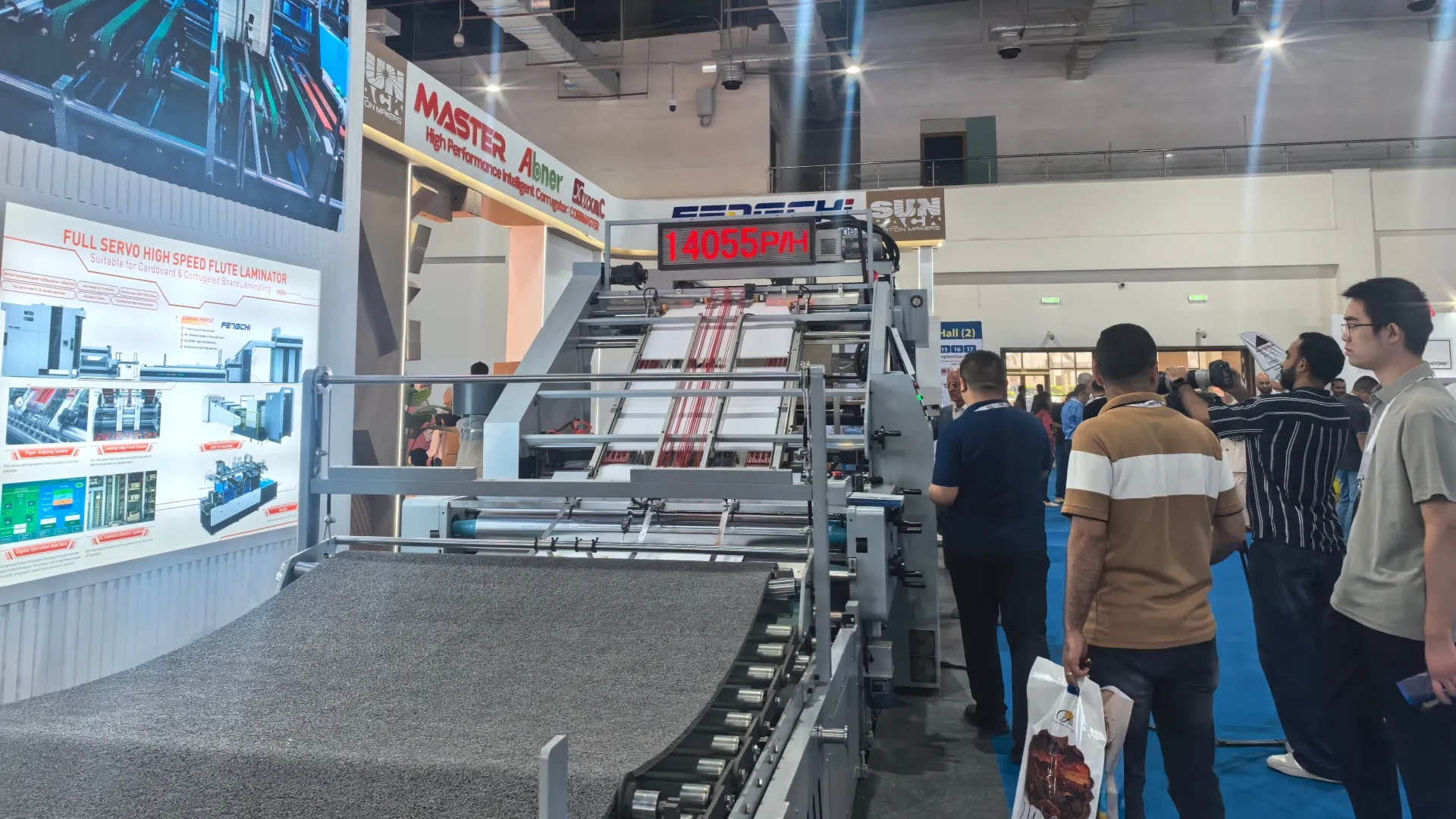
Yes. You can schedule a factory acceptance test at Fengchi’s Dongguan facility, or arrange a visit to a nearby customer site running the machine. Fengchi also regularly exhibits at international trade shows including SinoFoldingCarton (Shanghai/Shenzhen), drupa (Düsseldorf), and ExpoPrint (São Paulo), where machines run live. Contact a sales engineer to discuss demonstration options in your region.