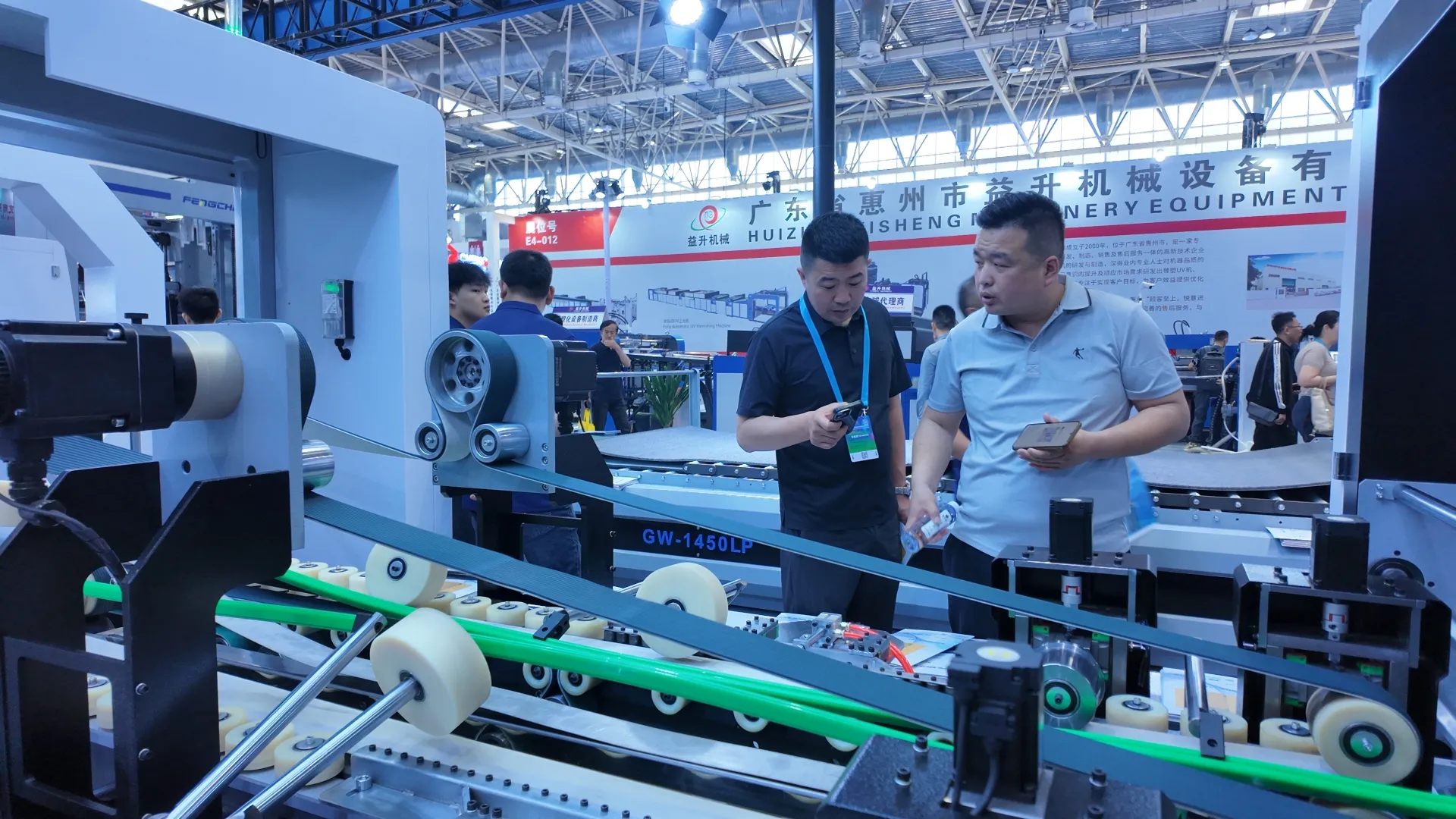
If you run a corrugated or litho-laminating line, you know the delivery end of a flute laminator is where bottlenecks hide. Sheets come off the laminator at 12,000–16,000 per hour — but then what? Two or three workers manually grab, flip, count, and stack them onto pallets. They get tired. Stacks come out crooked. And worst of all, freshly laminated sheets warp overnight because they were stacked in the same direction.
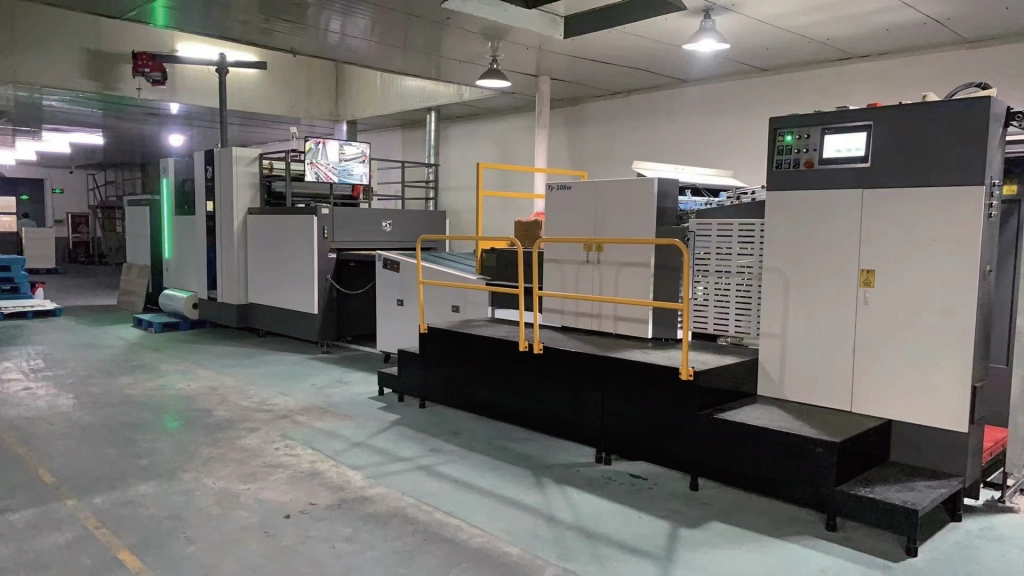
That’s exactly the problem a flip flop stacker solves. It’s a downstream machine that sits at the end of your flute laminator and automatically receives, turns, counts, and stacks laminated corrugated sheets — alternating the direction of each stack to prevent warping. One machine replaces two to three manual workers, eliminates the bottleneck, and produces pallet-ready stacks that stay flat.
This guide explains what a flip flop stacker is, how it works, and why corrugated packaging plants around the world use it to lower labor costs and protect output quality.
See the Flip Flop Stacker in Action
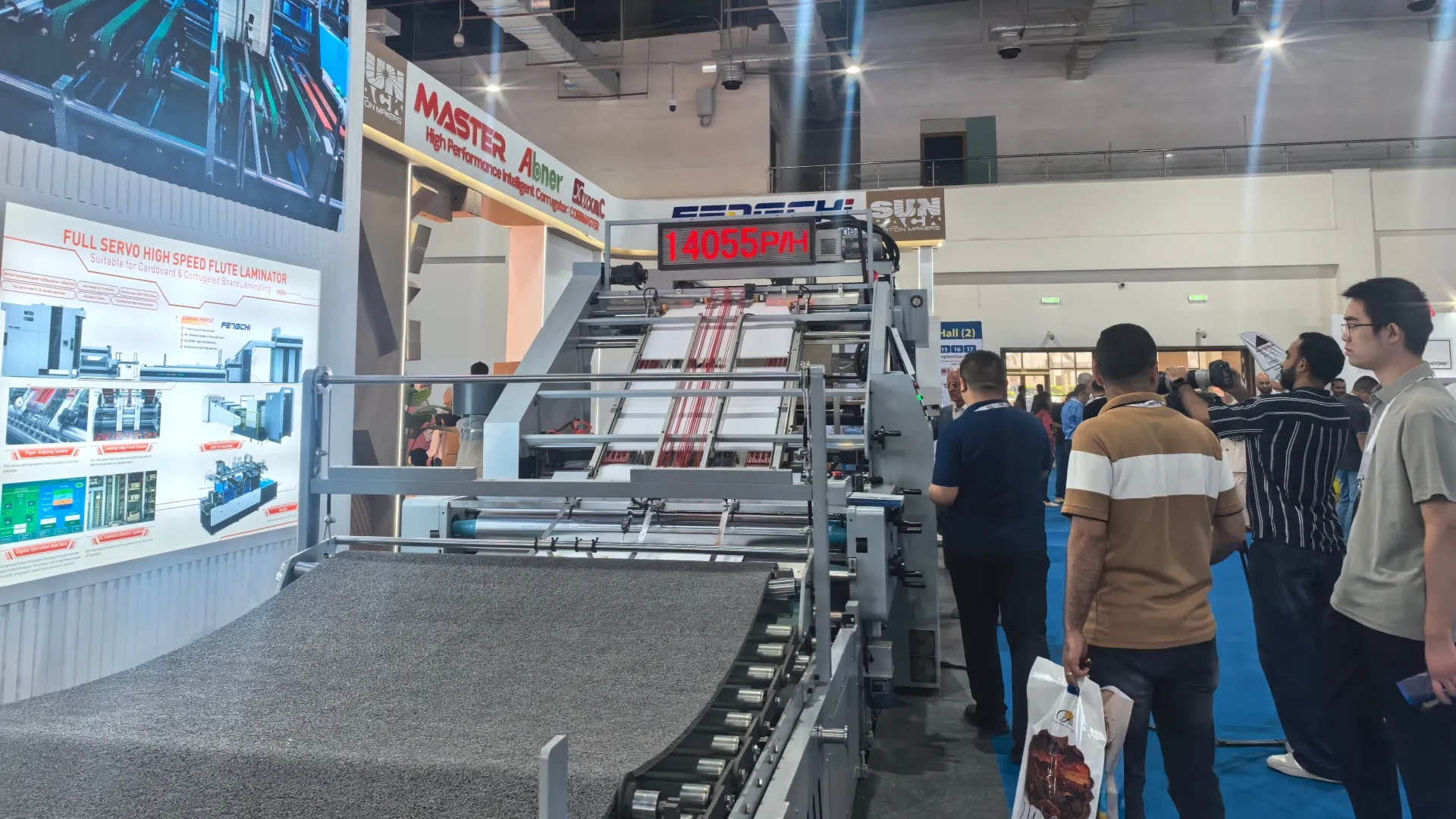
Watch how the FZ Series flip flop stacker integrates seamlessly with a high-speed flute laminator — automatically receiving, turning, stacking, and palletizing laminated sheets without slowing down the production line.
Watch more machine demos on the Fengchi YouTube Channel →
The Core Problem: Why Manual Stacking Creates a Bottleneck
Most packaging plants start with a flute laminator and a crew at the delivery end. At 10,000 sheets per hour, each worker grabs roughly 2–3 sheets per second, flips them, aligns them, and builds a straight stack — for eight hours straight. It’s physically impossible to sustain at full speed.
The real-world consequences:
- Speed mismatch. The laminator can run faster than workers can stack, so operators slow the machine down — losing 20–30% of rated throughput.
- Inconsistent pile quality. Manual flipping produces uneven stacks. Sheets slide during pallet transport. Downstream die-cutting machines jam on crooked stacks.
- Board warping. When you stack freshly laminated sheets all facing the same direction, the top liner and bottom liner absorb and release moisture at different rates. Within 8–24 hours, the entire stack curls — see the explanation below.
- Labor dependency. If one worker calls in sick, the whole line slows down. In markets with rising labor costs, this dependency erodes margins fast.
The flip flop stacker removes all four of these problems simultaneously.
How Does a Flip Flop Stacker Work?
The working process can be broken into four simple steps:
Stage 1: Receiving
Laminated sheets enter the stacker from the laminator’s delivery belt. The slow paper table acts as a buffer — it receives sheets at laminator speed and transitions them into the stacker’s internal rhythm. This prevents pile-ups and keeps the laminator running at full speed without interruption.
Stage 2: Accumulation
Sheets are collected into a counted pile on the stacking table. An auto-counting sensor tracks exactly how many sheets have accumulated — typically configurable from 50 to 500 sheets per pile, depending on board thickness. Once the preset count is reached, the pile is released to the turning table.
Stage 3: Turning
This is the defining feature. The accumulated pile enters the turning table, where a servo-driven flipping mechanism rotates the entire stack 180 degrees. The system alternates: pile 1 goes through right-side-up, pile 2 gets flipped upside-down, pile 3 right-side-up, and so on.
For jobs that don’t require flipping (e.g., thin single-face board), operators can disable flip mode via the touchscreen — the stacker simply passes piles through without turning.
Stage 4: Delivery
After flipping (or passing through), each pile is conveyed to the receiving table and deposited onto a pallet. Built-in side and front joggers align each pile to produce perfectly square stacks. An optional non-stop pallet change function lets operators swap full pallets without pausing the machine — critical for high-volume shifts.
Why Alternating Stack Direction Matters
The “flip flop” name comes from this alternating behavior, and it’s not a gimmick — it solves the #1 post-lamination quality defect: board warping.
During flute lamination, adhesive introduces moisture into the board. The face paper and corrugated medium absorb this moisture at different rates, causing differential shrinkage. Stack 500 sheets all facing the same direction, and the entire stack curls within hours as one side dries faster than the other. Three common warp types result: upward curl (inner liner too moist), downward curl (face paper too moist), and S-warp (uneven moisture across the sheet width).
By flipping every other pile 180 degrees, the flip flop stacker alternates sheet orientation in the stack, allowing moisture to equalize evenly. Warping drops from a 15–25% reject rate to under 3%, based on real production data from plants running full-servo Fengchi stackers.
Bottom line: The alternating flip isn’t just about neat stacking. It’s a moisture management strategy that saves you from remaking thousands of warped sheets.
Key Technical Specifications
When evaluating a flip flop stacker for your production line, compare these parameters directly. Below are the real specifications for Fengchi’s FZ Series full-servo flip flop stackers — data sourced from production units and export technical documentation.
| Parameter | FZ-1450 | FZ-1700 | FZ-2100 |
|---|---|---|---|
| Max Sheet Size | 1450 × 1450 mm | 1700 × 1650 mm | 2100 × 1650 mm |
| Min Sheet Size | 500 × 380 mm | 550 × 380 mm | 600 × 380 mm |
| Max Speed | 15,000 sheets/hr | 15,000 sheets/hr | 15,000 sheets/hr |
| Power | 12 kW | 12 kW | 14 kW |
| Voltage | 380 VAC / 3P | 380 VAC / 3P | 380 VAC / 3P |
| Air Pressure | 0.8 MPa | 0.8 MPa | 0.8 MPa |
| Weight | 3,800 kg | 4,000 kg | 5,600 kg |
| Dimension (L×W×H) | 6955 × 2432 × 2892 mm | 7555 × 2682 × 2892 mm | 9120 × 2910 × 2892 mm |
| Control System | Full servo motion control system | Full servo motion control system | Full servo motion control system |
Flip Flop Stacker vs. Manual Stacking: ROI Comparison
Here’s a head-to-head comparison for a typical 10-hour shift running at 12,000 sheets per hour:
| Factor | Manual Stacking (3 Workers) | FZ-1450 Flip Flop Stacker |
|---|---|---|
| Effective throughput | ~8,000 sheets/hr (limited by worker fatigue) | 12,000–15,000 sheets/hr (full laminator speed) |
| Labor per shift | 3 workers × 10 hrs | 0–1 worker (supervision only) |
| Annual labor cost (est. $5/hr) | ~$39,000 / year | ~$0–6,500 / year |
| Warping reject rate | 15–25% | < 3% |
| Stack alignment | Inconsistent (±15–20 mm) | Precision-aligned (±2 mm) |
| Changeover time | 10–15 min (manual adjustment) | ~2 min (touchscreen one-key) |
| Pallet change downtime | 2–3 min (line stops) | 0 min (optional non-stop) |
| Typical payback period | — | 12–18 months (labor + waste savings) |
For most medium to high-volume corrugated plants, the labor savings alone cover the machine cost within 12–18 months. Add the value of recovered throughput and reduced waste, and the actual payback is often under 12 months.
Features to Look For in a Flip Flop Stacker
Not all stackers are built the same. Here’s what separates production-ready equipment from budget alternatives:
- Full-servo motion control — Servo-driven flipping and lifting ensure repeatable positioning, fewer jams, and consistent quality across millions of cycles.
- High-speed silent track — A wear-free track system for the turning mechanism eliminates the metal-on-metal contact that causes noise and premature wear.
- Bus control with one-key setup — Multiple servo axes communicate over a real-time bus. Type the sheet dimensions on the touchscreen and the entire machine reconfigures automatically — no tools, no manual adjustments.
- Three-section independent speed control — Separate frequency converters for receiving, turning, and delivery sections adapt belt speed to different board thicknesses on the fly.
- Non-stop pallet change — Optional feature that buffers one pile while the operator swaps the full pallet underneath. Zero downtime for pallet changes.
Frequently Asked Questions
What is a flip flop stacker used for?
A flip flop stacker automatically receives, turns, and stacks corrugated sheets coming off a flute laminator. It alternates stack direction to prevent board warping caused by moisture imbalance, while reducing manual labor at the delivery end.
How fast can a flip flop stacker run?
Modern full-servo flip flop stackers from Fengchi run at up to 15,000 sheets per hour, matching the output of high-speed flute laminators. Entry-level models typically handle 10,000–12,000 sheets per hour.
Can it integrate with my existing litho laminator?
FENGCHI stackers integrate directly with FENGCHI laminating lines. For third-party machines, send your line speed, sheet range, and delivery height to our engineers and we will assess the integration.
Does the stacker still need operators?
Yes, but usually one supervisor is enough. The machine handles the physical stacking and pallet change, while the operator monitors quality and job settings.
Get a Flip Flop Stacker Recommendation
Choosing a stacker is not just about the machine itself; it is about matching it to your laminator, sheet sizes, board types, and target output. Tell us your production requirements and our engineers will recommend the most cost-effective automatic flip flop stacker for your factory.